


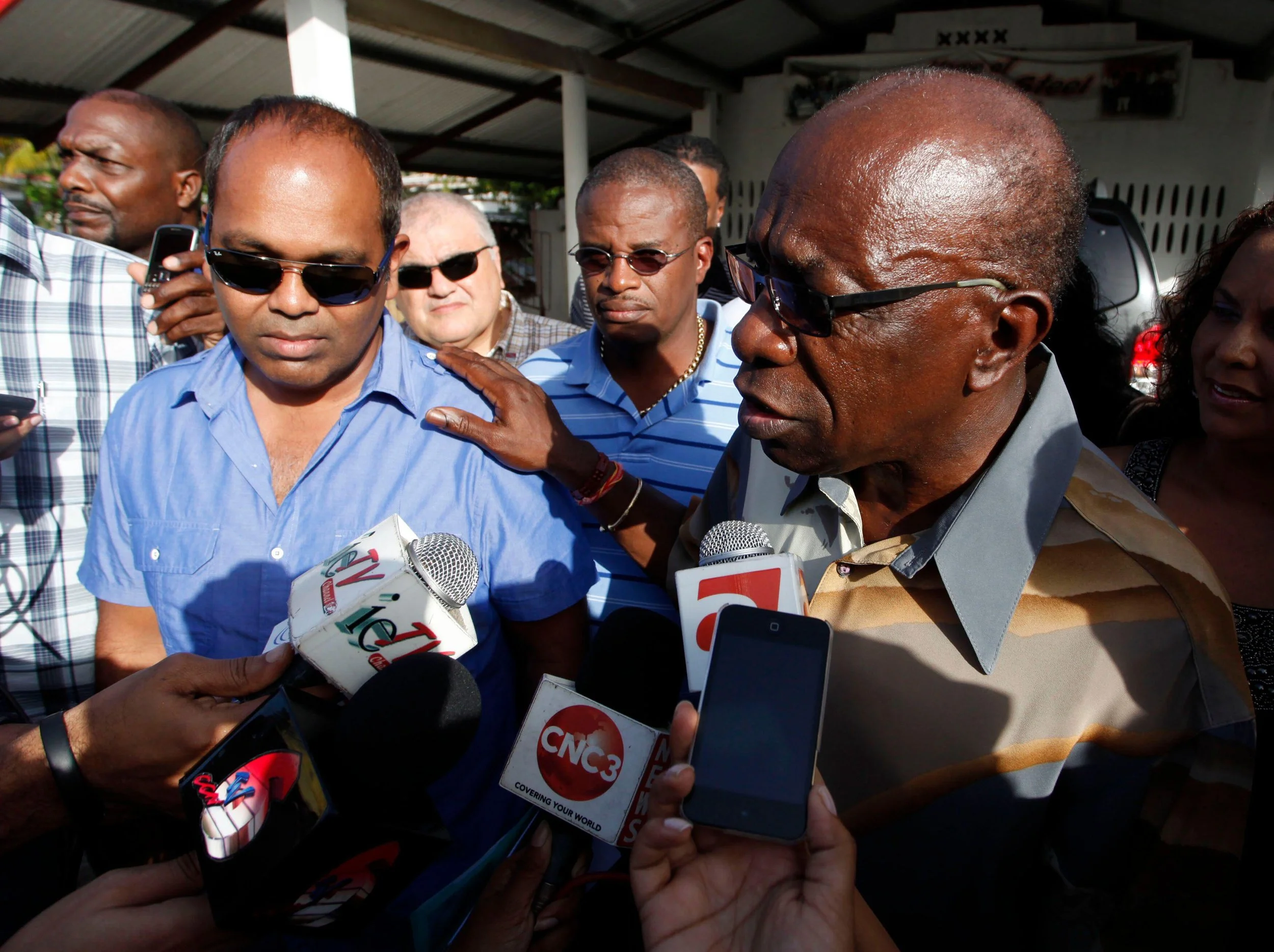
Om Lalla (na sliki levo), danes slovenski častni konzul v Trinidadu in Tobagu, leta 2001 s svojo stranko, nekdanjim podpredsednikom Fife Jackom Warnerjem, ki se zdaj bori proti izročitvi ZDA zaradi korupcije in podkupovanja.
How Slovenia’s Honorary Consul in Trinidad Helped Cambridge Analytica
Since 2013, Slovenia has had an honorary consul in Trinidad and Tobago, a Caribbean island nation. Oštro and OCCRP have revealed that he played a significant role in an electoral engineering campaign carried out in the country in 2010 by the predecessor of the now-infamous Cambridge Analytica, which was funded by former FIFA vice-president Jack Warner.
Disgraced former FIFA vice-president Jack Warner funded a disinformation campaign in Trinidad and Tobago, carried out by an international electioneering firm to discourage Afro-Trinidadians from voting in parliamentary elections.
Warner is currently fighting extradition to the United States, where he faces corruption charges. Among other allegations, he is accused of accepting a $5 million bribe in exchange for helping secure Russia’s hosting of the 2018 FIFA World Cup. (Which it did.)
His involvement in the pre-election campaign “Do So!” (Do It), run by SCL, the predecessor of Cambridge Analytica, has not previously been publicly revealed. The campaign, which likely influenced the outcome of Trinidad’s 2010 elections in favour of the United National Congress (UNC), used graffiti, billboards and music videos to discourage young Afro-Trinidadians from voting.
According to a written statement submitted to the FBI by a former SCL employee and obtained by Oštro and the Organized Crime and Corruption Reporting Project (OCCRP), Warner funded the Do So! campaign. Oštro and OCCRP found that his lawyer, Om Lalla, helped him do so, acting as Warner’s representative to SCL during the campaign.
At the time, Warner’s career in international football was already drawing to a close amid allegations that he had traded favours for money. Nevertheless, after entering parliament in 2007, he was laying the groundwork for the next chapter of his career as a Trinidadian politician.
Sven Hughes, former director of SCL’s elections division, told Oštro and OCCRP that the company had connected with Trinidad’s opposition through regional contractors, including in Saint Kitts and Nevis, where SCL had reportedly claimed to have influenced election outcomes. SCL has been insolvent since 2019.
The 2010 elections in Trinidad and Tobago were critical in many respects, as the incumbent prime minister was vulnerable after three terms in office. In the context of those elections, SCL’s role was “truly frightening,” says Emma Briant, a researcher at Bard College in the UK who studies information warfare and propaganda.
In her view, Oštro and OCCRP’s findings confirm the need for better oversight of companies that seek to influence society. In Trinidadian politics, “there is racial division, and everyone can choose whether to play that card or find something else.”
Plotting
SCL was founded in the 1990s by British businessman Nigel Oakes. The company invested $20 million in developing an “advanced methodology for persuasion”. It later focused on “electoral management” and other campaigns in Africa, Asia and the Caribbean.
Alexander Nix also joined the company, taking charge of its electoral projects before going on to establish Cambridge Analytica, the infamous political consultancy that helped Donald Trump win the 2016 US presidential election.
Long before Nix and Cambridge Analytica entered Trump’s orbit, Oakes had already been working in the Caribbean under the SCL umbrella.
In April 2010, Hughes, Nix and lawyer Om Lalla, now Slovenia’s honorary consul, met with Warner in his office, which was filled with FIFA memorabilia, and devised a plan. “Warner showed us his FIFA awards, photographs, posters, and then … we got down to work,” Hughes recalled in an interview with Oštro and OCCRP.

They agreed that SCL would launch a street-level communications campaign ahead of Trinidad’s 2010 elections to demonstrate to the UNC what it could achieve. As Hughes explained, Warner would later use his influence to arrange a meeting between SCL and Kamla Persad-Bissessar, who was then poised to become the country’s next prime minister. They hoped she would agree to hire SCL to run a nationwide campaign for the party, at a cost of between $4 million and $5 million.
An email obtained by Oštro and OCCRP shows that in April 2010, Warner’s lawyer, Om Lalla, sent Hughes a list of constituencies where close results were expected and which the campaign subsequently targeted.
The following month, Lalla told Hughes that he could contact Warner’s secretary to arrange payment for the campaign: “She has $62,000 ready for SCL. She also has $15,000 ready for the licence for the Do So campaign.”
Lalla told Oštro and OCCRP that he could not comment on the campaign out of respect for attorney-client privilege. Warner did not respond to a written request for clarification and comment. When a journalist from Oštro and OCCRP called him by phone, he said he would not answer any questions because he was not interested in doing so.
While payment for the services was still being negotiated, Hughes was already preparing the campaign. Its name, “Do So!”, was inspired by an elderly Trinidadian man who refused to let the incumbent prime minister enter his yard while campaigning door to door ahead of the election. He folded his arms across his chest and stood his ground.
“Bingo! I had found my voter behaviour modification campaign, or ‘psychological judo’, to be precise,” Hughes wrote in a statement that he says he submitted to the US Federal Bureau of Investigation (FBI) in 2019.
He recalled how he came up with the campaign in his hotel room: “A pair of black arms crossed over the chest, with the slogan DO SO! underneath, printed against the yellow background of the UNC party.” The message was that young people should similarly cross their arms in defiance and abstain from politics.
For young people
The Do So! campaign, which encouraged young people to rebel against politics by adopting an apolitical stance, gained considerable traction among young people during the pre-election period in Trinidad. However, it also became notorious. In 2019, Netflix released a documentary about Cambridge Analytica in which the campaign was cited as one of the key pieces of evidence that the company was conducting covert influence campaigns.
Approximately half of the population of Trinidad and Tobago is of African descent, while the other half is of Indian descent. The Netflix documentary also featured secretly recorded footage of Alexander Nix boasting that increasing voter apathy and discouraging young Afro-Trinidadians from voting were key objectives of the campaign, since SCL’s client was more popular among Indo-Trinidadians.
Nix described the campaign’s message as follows:
»Don’t vote. … Don’t get involved in politics. It’s a sign of rebellion—not against the government, but against politics. And elections …«

»We knew that Afro-Caribbean young people wouldn’t vote because they ‘Do So’ [that’s what they do]. But all the Indian kids would do what their parents told them to do, which was to go out and vote.«
In his response to Oštro and OCCRP, Hughes insisted that the campaign had not targeted voters based on race and that he had conceived and carried it out himself, without Nix or Bertie, as he is known.
»It was absolutely not a campaign designed to create divisions,« he assured the journalist.
However, a report on the polling results that SCL prepared for the UNC party and that Oštro and OCCRP obtained states that the campaign should focus specifically on Afro-Trinidadians.
Researcher Emma Briant said that “it is somewhat naive to think that [the campaign] was not pitting different ethnic groups against one another.«
»They used methods that were essentially designed to win the support of young people, while reinforcing the deepening of ethnic divisions in electoral decision-making. They were working with people who didn’t really care about young people in this country … and doing so in a way that clearly sought to encourage social divisions,« she added.
In the wake of the bribery scandal.
Despite the relative success of the Do So! campaign, SCL never secured the major contract it had hoped for.
»Warner arranged our meeting with Kamla … but Bertie messed it up,« Hughes recalled. »Kamla clearly didn’t like his long-winded style, with all those pages in the presentation, and told him to hurry up. He was deeply offended by that, but carried on with the presentation.« Hughes says Nix eventually got into an argument with her and was escorted out of the room.
However, in 2010, the UNC party did win the parliamentary elections as the leading member of the People’s Partnership coalition. Warner became Minister of Works and Transport and later Minister of National Security.
CA Political, a sister company of Cambridge Analytica that focused on political campaigns, boasted on its website that it had influenced the 2010 elections in Trinidad and Tobago and helped elect Persad-Bissessar as prime minister.
Warner was eventually dogged by corruption allegations. In 2011, FIFA suspended him over allegations that he had arranged for bribes to be paid to members of the Caribbean Football Union. Shortly afterwards, he resigned as FIFA vice-president and as president of Concacaf, the influential football confederation for North America, Central America and the Caribbean.
In addition to bribery, Warner was accused of withholding bonuses owed to Trinidadian footballers, stealing money from a fund for victims of the earthquake in Haiti, allowing his son to sell tickets to the FIFA World Cup on the black market or through the family’s travel agency, and building a $26 million Concacaf property on land he owned.
In 2015, he was caught up in one of the biggest bribery scandals in football history. According to allegations by the US government, he had received millions of dollars in bribes from South African officials in exchange for securing delegates’ votes in favour of South Africa hosting the 2010 FIFA World Cup. (Which it did.)
Later that year, FIFA banned him from all football-related activities for life.
In 2018, Nix became the public face of Cambridge Analytica’s downfall. British broadcaster Channel 4 News released undercover footage showing Nix pitching the company’s techniques to prospective clients—undercover journalists—including setting up compromising situations involving politicians and using bribery.

Our Man in Trinidad
Warner’s lawyer, Om Lalla, acted as Warner’s representative in negotiations with SCL over the 2010 Do So! campaign. He arranged payments and meetings. This is evidenced by documents obtained by Oštro and OCCRP, including emails, project budgets, agreements and other records. Hughes also confirmed that Lalla had acted as Warner’s representative.
In 2013, during Alenka Bratušek’s government, Lalla was appointed Honorary Consul of the Republic of Slovenia in Port of Spain, Trinidad and Tobago.
As Oštro reported in November, when it published the international project Diplomats in the Shadows, led by the International Consortium of Investigative Journalists, honorary consuls typically perform consular duties, help develop and maintain economic relations between the two countries, and carry out similar activities. Under the rules governing honorary consular officers, the Ministry of Foreign Affairs checks candidates’ backgrounds and is supposed to repeat these checks every five years after their appointment.
Neither Karl Erjavec, the foreign minister at the time, nor Alenka Bratušek, the prime minister at the time, remembers Lalla’s appointment.
Under freedom of information legislation, the Ministry of Foreign Affairs provided Oštro with a draft decision on Lalla’s appointment, which had been prepared as early as 2011. The document indicates that the officials responsible for preparing the proposal and ensuring its coordination were Aljaž Gosnar, then Secretary-General of the Ministry of Foreign Affairs, and Metka Ipavic, head of the department for North America, Latin America and the Caribbean.
The draft decision states that »it is unrealistic to expect Slovenia to expand its diplomatic network in the region in the near future«. The primary objective was to strengthen economic cooperation, as »the Republic of Trinidad and Tobago is one of the most important economic centres in the Caribbean«.
Gosnar, now a retired diplomat, did not remember the appointment either. He explained, however, that he had been appointed ambassador to Madrid at the end of that year and had left the ministry. He also recalled that, at the time, the ministry required candidates for honorary consul positions to visit Slovenia before their appointment.
Metka Ipavic, who is now Slovenia’s ambassador to France, did not respond to Oštro’s request for an interview.
We knew that Afro-Caribbean young people wouldn’t vote because they ‘Do So’ [that’s what they do]. But all the Indian kids would do what their parents told them to do, which was to go out and vote.
In an interview with Oštro, Erjavec explained that Slovenia has a small diplomatic network and that, at the time, a decision had been made to fill the »gaps« in the network with honorary consuls, who could provide consular services to Slovenian citizens in countries without a Slovenian diplomatic mission.
Until 2013, Slovenia indeed had no consular representative in the Caribbean. That year, however, it appointed two. Lalla was appointed honorary consul in April, followed three months later by Geoffrey Handal in Haiti.
Andrej Šter, head of the consular department at the Ministry of Foreign Affairs, told Oštro that »the need for consular services was certainly not the reason for appointing an honorary consul in Trinidad and Tobago«.
In a 2014 report he submitted to Slovenia’s Ministry of Foreign Affairs, Lalla also reported on a visit to Slovenia. In February, he met with four ministry officials in Ljubljana, including Vladimir Kolmanič, then head of the department for North America, Latin America and the Caribbean, and Brian Bergant, the chief of protocol, who is now Slovenia’s ambassador to Argentina. Bergant did not remember Lalla’s appointment, while Kolmanič’s phone number is no longer in service.
We asked the Ministry of Foreign Affairs whether Lalla’s activities in Trinidad — namely, his involvement with Warner in a campaign of electoral engineering — were consistent with the rules governing honorary consuls, who are required to ensure that their actions do not harm Slovenian interests.
»The key consideration when appointing an honorary consular officer is that, if they are politically active or otherwise engaged in public life, they must conduct such activities in a manner that does not harm the interests of the Republic of Slovenia. As part of the assessment of a candidate’s suitability, documentation confirming that the candidate has no criminal record and is not subject to criminal proceedings is also examined, among other things. It is likewise verified whether the candidate’s professional and other activities are compatible with the position of honorary consular officer.«
They explained that Lalli’s candidacy had been vetted by the Slovenian institutions, which concluded the process by issuing an exequatur following approval and the submission of a letter of appointment from the Government of Trinidad and Tobago. This formal authorization allowed Lalli to assume the role of honorary consul.
»The Ministry of Foreign and European Affairs cannot assess the specific activities you have mentioned, as, among other things, it is not familiar with the electoral and lobbying legislation of Trinidad and Tobago, nor is it competent to interpret such legislation.«
They also do not have a report from the local electoral commission in which »the alleged electoral engineering in 2010 was supposedly highlighted«. They further explained that Lalla has not been convicted by a final court ruling and is not facing criminal proceedings.
»If any official proceedings had been initiated against the honorary consul in connection with the alleged activities, the Ministry of Foreign Affairs would certainly have taken action.«

Be Our Wind!
We want to build a community with you. Join Oštro.
What do you gain by joining us? We have prepared three programmes.

2026 © Oštro